
Carbon Footprint Tracker
Discover how your everyday transactions impact your estimated carbon footprint in the Westpac App.
What's a carbon footprint?
Whenever we go places, eat things, or use and buy new stuff, we’re contributing to the growing amount of greenhouse gases in the atmosphere. A carbon footprint measures the amount of carbon dioxide equivalents produced as we go about our daily lives. To help you understand and track the carbon footprint of your transactions, we've integrated a Carbon Footprint Tracker into the Westpac App.
Why use our Carbon Footprint Tracker?
Based on the transactions you make using eligible Westpac accounts, including transaction and credit card accounts, the Westpac Carbon Footprint Tracker will help you understand and keep track of your estimated carbon footprint.
Compare your footprint against individual and Australian household averages, to better help you understand where you could make changes to live more sustainably.
Did you know?
The average Australian household is 2.5 people*.
Here's how it works
With the help of our partner Cogo, estimates of your carbon footprint are calculated based on the whole transaction amount, not the individual items in it. So, if you go for lunch at a café, the whole bill, not individual menu items, is used in the calculation.
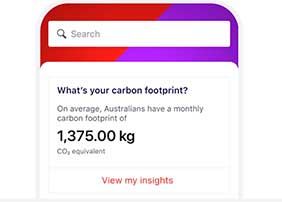
1. View
Search Carbon Footprint Tracker or simply scroll until you see What’s your carbon footprint? Follow the prompts to view.
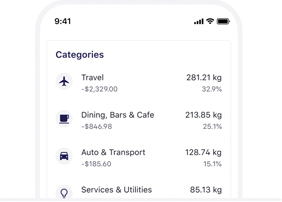
2. Customise
Transactions are automatically categorised, but you can edit them for more relevant results if you like.
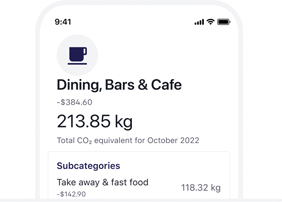
3. Measure
Each category has been assigned an average carbon emissions factor by Cogo. These averages are used to calculate the estimated carbon footprint of your transactions.
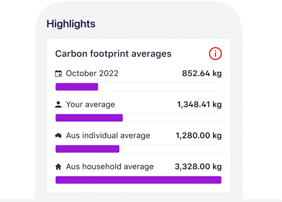
4. Learn
Easy-to-read charts let you see how your estimated carbon footprint changes over time, as well as how you compare to Australian averages.
Let's get you started
Keep your journey going
The more you know, the better equipped you are to make decisions that may help reduce your carbon footprint. If you'd like to learn more, these resources are a great next step.

Understanding your carbon footprint
What is carbon footprint, how to measure it, and how you could manage yours is a helpful step towards making a positive change.

Small changes could make big impacts
Simple, quick and practical tips that could give you the knowledge and power to act and make choices to live more sustainably.

Making sustainable living an easier choice
Learn how we’re supporting your choices with products, services, tips and ideas to inspire and support your sustainable living goals.
How we're seeking to reduce our carbon footprint
Our goal is to become a net-zero, climate resilient bank and we have an action plan to get there.
Frequently asked questions
The Westpac App uses two pieces of data to calculate your estimated monthly carbon footprint: the transaction amount, and the transaction’s industry category which has an associated emissions factor calculated based on Australian industry average data. Each eligible transaction is multiplied by an 'emissions factor' (how much greenhouse gas that type of activity emits per dollar spent) to work out the estimated carbon footprint for that transaction.
Our partner, Cogo, has provided these emission factors, mapped to their comprehensive database of industry categories (e.g., home energy, petrol, groceries, fashion, etc) for Australia. For example, $50 spent at an Australian grocery retailer creates, on average, 17.8kg CO2e, the equivalent of driving an average car for 90km.
Your estimated carbon footprint is based on the total transaction amount, and not the individual items making up that purchase.
We calculate your estimated carbon footprint using an industry-specific emissions factor assigned to the specific category allocated to the merchant (the retailer) from which you made your purchase. Our partner, Cogo, has mapped Australian-specific emission factors (e.g., utilities, petrol, groceries, clothes & shoe shopping etc.) to industry categories that we apply to eligible transactions from included accounts in the Westpac App. When we calculate your carbon footprint, it’s an estimate based on the total transaction amount, not the individual items making up that purchase.
Currently, the Westpac Carbon Footprint Tracker does not consider all of the environmental or lifestyle choices you make that may reduce your carbon footprint. The Tracker uses average Australian industry data that is supplied by our partner, Cogo, to calculate the estimated carbon footprint associated with eligible transactions.
Here are examples of what's included in some categories:
Groceries
We can't see the individual grocery items that you purchase or see your specific dietary choices. Therefore, we use an average Australian grocery emissions factor to calculate your estimated carbon footprint for transactions within the ‘Groceries’ category.
Energy and Electricity
While we can see the energy or electricity provider you use, we can’t see whether you're buying just electricity or natural gas. We use average Australian emissions factors, which are high due to Australia's overall reliance on coal and other non-renewable energy sources.
Shopping
We can't see the individual items or brands you purchase, so we use average emissions factors per type of shopping category (e.g., clothes & shoes) to calculate your estimated carbon footprint, taking into account the global supply chain.
In this context, the global supply chain refers to the raw materials being used and transported between countries to create a finished product. The finished product is also generally transported between countries until it reaches the final consumer.
Most eligible transactions are automatically assigned to an industry category with an associated estimated carbon footprint emissions factor. Transactions where the category can’t be identified by us will be shown as ‘Uncategorised’. An estimated average emissions factor, made up of a weighted average emission factor across all sectors, will be applied.
You can easily change the category applied to a transaction by tapping on the transaction, and under ‘Subcategory’ tap ‘Edit’, then choose the category you feel best fits the transaction. We provide some suggestions based on the transaction description. The App will continue to learn as you update your subcategories and categorise future transactions similarly.
Every transaction, whether for a product or service, can be a source of emissions. Mortgage or home loan repayments are no different. When you make a loan repayment, you're typically paying for a few different things: interest, administration charges, and paying off a portion of the principal. Most components of a mortgage repayment have a carbon footprint. The emissions factor applied is based on the estimated average emissions of entities that our partner Cogo considers form part of the Australian Financial Services industry.
Simply tap on the transaction, then under ‘Subcategory’ tap ‘Edit’, and choose the category you feel best fits the transaction. We provide suggestions based on the transaction description. The App will continue to learn as you update your subcategories and categorise future transactions similarly.
Transactions that show as ‘Pending’ can’t be categorised until they’re finalised (settled), so won't appear in your Carbon Footprint Tracker insights. They’ll be included once they are finalised (settled).
Need to download the Westpac App?


Things you should know
Read the Westpac Online Banking Terms and Conditions (PDF 713KB) at westpac.com.au before making a decision and consider whether the product is right for you.
This information is general in nature and has been prepared without taking your objectives, needs and overall financial situation into account. For this reason, you should consider the appropriateness for the information to your own circumstances and, if necessary, seek appropriate professional advice.
Last updated 1 Mar 2025.
The information provided relates to environment, social and governance (ESG) topics, including but not limited to climate change, targets, projections, scenarios, and other proxy data. All facts on our Sustainable Living Ideas website and CO2e values are estimates. The science, methodologies and data quality and availability relating to ESG topics are rapidly evolving and maturing, including the available data and variations in approaches and common standards in estimating and calculating emissions. There are inherent limitations in the current scientific understanding of climate change and its impact. Carbon footprint estimates are calculated based on industry averages only and are not specific to individual purchases or merchants. The calculations compare transactions conducted via eligible Westpac accounts against industry data provided by Connecting Good Australia Pty Limited (Cogo). Transactions categorised as pending or transfers aren’t included. All facts and CO2e values are estimates provided by and published with the permission of Cogo. The information is based on research at an industry level, will be updated as more information becomes available, and Cogo is responsible for its accuracy and completeness. Westpac gives no representation, warranty or guarantee (including as to the quality, accuracy or completeness) of this information. Climate and sustainability related forward-looking statements are not guarantees or prediction of future performance. Actual outcomes may differ from those expressed or implied and are not guarantees or predictions of future performance.
*Source: GlobalData PLC 2022
For more information on Cogo, visit www.cogo.co.
Read our Privacy Statement for more information about how we handle your personal information.
iPhone, iPad, iPod touch and Apple Watch are trademarks of Apple Inc., registered in the U.S. and other countries. App Store is a Service mark of Apple Inc.
Android, Google Play and the Google Play logo are trademarks of Google LLC.