Skip to main content Skip to main navigation
Skip to access and inclusion page Skip to search input

Australians maintain interest in regional living

Australians continue to show strong interest in regional living, driven by affordability and lifestyle benefits, even as capital cities remain the dominant choice overall. According to the latest Westpac Home Ownership Report, 28% of Australians plan to buy, invest or rent in regional areas. Interest has remained steady over the past year, indicating regional Australia continues to be viewed as a viable and appealing option rather than a short-term trend.

Fast facts

>25%

of Australians are planning to buy, invest or rent in a regional area


1 in 3

Australians have consistently considered a move outside the capital cities year-on-year

34%

cite lower cost of living and 33% point to more affordable house prices as the main reasons for a regional move


32%

say the biggest concern is distance from healthcare and schools


Regional interest remains consistent

Between January 2024 and October 2025, the share of Australians considering a move to regional areas remained steady at around three in 10. Over the same period, the number of people planning to purchase in a capital city increased to 55%, reinforcing that capital cities remain the primary focus for most buyers.

However, the continued level of regional interest suggests Australians are actively weighing their options, balancing affordability and lifestyle with access to essential services and employment.


James Hutton, Westpac Managing Director Mortgages

“Regional Australia remains a compelling option for buyers seeking value and space,” Mr Hutton said.

“What’s notable is the consistent interest in regional moves rather than a surge – Australians are weighing affordability and lifestyle alongside proximity to healthcare, education and job opportunities.”

What’s driving interest in regional areas

Affordability remains the strongest motivator for Australians considering a regional move. Lower cost of living (34%) and more affordable house prices (33%) top the list, reflecting ongoing pressure on household budgets in many capital cities.

Lifestyle considerations also play an important role. More than one quarter (28%) are attracted to less populated environments, while a desire for more space and proximity to nature (both 24%) highlights the appeal of regional living beyond cost alone.

Together, these factors point to a pragmatic mix of financial and lifestyle priorities shaping regional intentions.


Concerns buyers are weighing up

While interest remains strong, many Australians considering a regional move also report concerns.

Two thirds of those planning a regional move say they have reservations. The most common concern is distance from key facilities such as healthcare and schools (32%), followed by being further away from family and friends (27%).

Employment opportunities (23%) and fewer entertainment options (23%) are also important considerations. Among Gen Z, concern about limited entertainment options rises to 39%, highlighting generational differences in how regional trade offs are perceived.


Matthew Hassan, Westpac Senior Economist

“Affordability and lifestyle remain central to regional buying intentions. As infrastructure continues to improve and hybrid work persists, we expect regional interest to remain steady, not spike — consistent with the broader pattern in our data,” Mr Hassan said.

Regional areas showing lending growth

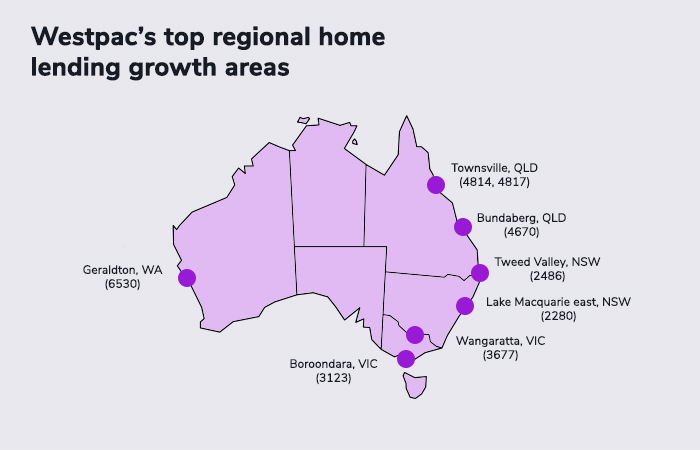
Westpac data shows home lending growth across a range of regional areas, reflecting continued demand outside capital cities.

Westpac’s top regional home lending growth areas include:

  • Geraldton, WA (6530)
  • Lake Macquarie – east, NSW (2280)
  • Townsville, QLD (4814, 4817)
  • Boroondara, VIC (3123)
  • Wangaratta, VIC (3677)
  • Bundaberg, QLD (4670)
  • Tweed Valley, NSW (2486)


Map of Australia showing Westpac's top regional home lending growth areas

Tips for buyers considering a regional move

For Australians thinking about buying or investing in a regional area, preparation and research are key.

  • Get pre approval and guidance
    Speaking with a regional home lending specialist can help you understand your borrowing power and act quickly when the right property becomes available.
  • Use property research tools
    Comparing suburbs, property values and local market trends can help buyers make informed decisions when exploring unfamiliar areas.
  • Understand the tradeoffs
    Regional living can offer affordability and lifestyle benefits, but it’s important to consider access to services, employment and long-term needs.


 

Other guides to help

Buying your first home

The key to a smoother experience is knowing what to expect. We're here to help every step of the way.

Support opportunities

With a government-backed grant or scheme you could become a homeowner sooner.


Family security guarantee

Another way to make saving a deposit for a home easier. Find out how the guarantee works.

Things you should know

Conditions, credit criteria, fees and charges apply. Residential lending is not available for Non-Australian Resident borrowers.

This information is general in nature and has been prepared without taking your personal objectives, circumstances and needs into account. You should consider the appropriateness of the information to your own circumstances and, if necessary, seek appropriate professional advice.

Any tax information described is general in nature and it is not tax advice or a guide to tax laws. We recommend you seek independent, professional tax advice applicable to your personal circumstances.

Key Fact Sheet for Home Loans


About the Westpac Home Ownership Report

The research was commissioned by Westpac and conducted by Lonergan Research in accordance with the ISO 20252 standard. Lonergan Research surveyed 2,000 Australians aged 18+ with surveys distributed throughout Australia including both capital city and non-capital city areas. The survey was conducted online amongst members of a permission-based panel, between 19 and 29 September 2025. After interviewing, data was weighted to the latest population estimates sourced from the Australian Bureau of Statistics.