Westerners are fleeing their countries in record numbers

This article has been kindly reproduced with permission from The Economist and was published on 22 March 2026.
After stepping down as New Zealand’s prime minister in 2023, Jacinda Ardern took up a role at Harvard University. Now she is based in Sydney. Ms Ardern’s decision to live abroad has struck a nerve with Kiwis, who were already worried about high levels of emigration. Anxiety over the former prime minister’s living arrangements hints at a wider trend across the West. Politicians focus on how many people migrate to their country. Less noticed is that people are leaving in record numbers. The rise of the “expat economy” will have profound consequences.
Governments do a poor job of tracking emigrants. Britain long had no exit checks. Lacking a proper exit system, America relies on a mixture of tax data, surveys and indirect methods. But the quality of the figures has improved enough to let The Economist produce the first broad measure of gross emigration from the West.
We looked at data from 31 countries, including Australia, Britain, Canada and Germany (but not America, where estimates remain flaky). We track the comings and goings of residents leaving on a permanent or semi-permanent basis (to exclude tourists and business travellers). Our best estimate is that 4m or so people left those places in 2024, about 20% more than before the pandemic (see chart).
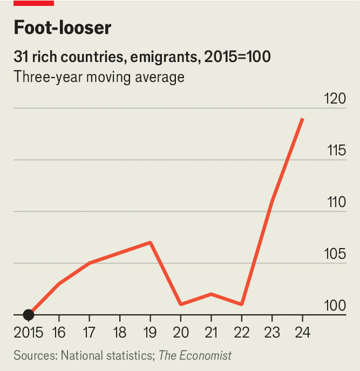
Emigration from Greece has fallen since the mid-2010s, as the Greek economy has turned from an EU laggard to star performer. But most places saw increases. In the third quarter of 2025 departures from Canada were 34% higher than six years before. New Zealand’s emigration in 2025 was 29% above 2019. In Sweden it was more than 60% higher. Italy’s statistics office recently noted a “boom in emigration”. Iceland’s reported the highest level on record. The Brookings Institution, a think-tank, estimates that as many as 3m people left America in 2025, up from 2m in 2021. Private-sector data suggest that, for the first time in years, more American tech workers are moving to Europe than vice versa.
The surge in emigration is, in part, the unwinding of an immigration boom in 2022 and 2023, when Western countries admitted legions of newcomers. Many of them never intended to stay for ever. Students graduate. Temporary workers go home. Donald Trump’s mass deportations may provoke up to 1m to leave in 2026, the Brookings data suggest, in addition to the 2m or so that would normally be expected. All these people show up as emigrants.
Higher churn among foreigners is not the whole story, however. In Ireland, departures of citizens are up by 29% compared with 2019. In New Zealand, they are up by 74%. Our analysis of OECD data finds a sharp increase in expat Americans, whose numbers rose by 11% from 2019 to 2024. Evidence of who becomes an expat is thin but official data from New Zealand suggest that people with at least an undergraduate degree are at least twice as likely to emigrate in their 20s as those without.
Some Western expats live it up in places like Dubai. War in the Gulf may change that. But even before the fighting started, most moved elsewhere in the West. Our analysis suggests that since 2019 the number of Western-born people living in another Western country has grown by about 2m. America has taken over 40% of that; many ambitious Europeans have gone there to make their AI fortunes. The Netherlands has taken an outsize share relative to its population. British data are too poor to analyse properly. Yet Hampstead is now full of Hollywood A-listers. Ryan Gosling buying bread! Rami Malek on a Lime bike!
Three factors explain the rise of the expat economy. First, the pandemic normalised geographical arbitrage. Once firms accepted that an employee could work from a kitchen table three hours away, why not farther afield? American multinationals in sectors such as management and technical consulting employ 36% more people abroad than they did in 2019.
Taxes are the second factor. In recent years many Western governments have implemented “Robin Hood” policies that go after rich people’s incomes. In Britain the top 1% pay an effective income-tax rate of about 40%, up from less than 35% in the 2000s. In America, the overall effective tax rate on the top 1%, including federal, state and local taxes plus corporate tax, is close to historical highs. Especially for people who do not expect to be high earners for long, it makes sense to temporarily move somewhere with lower taxes.
Third, politics play a role. Many Americans who waltz around Hampstead dislike Mr Trump. Many of the Britons who have moved to Dubai detest “Keir Starmer’s socialist Britain”. Conservative Canadians, now living through their 11th year of centre-left Liberal rule, are looking elsewhere. This points to the growing sense among Westerners of all political persuasions that politics is broken. Surveys show declining faith in democracy. A paper published last year by Assaf Razin of Tel Aviv University finds convincing evidence that “democratic decline tends to increase emigration”.
Sending countries can suffer. When a state invests in educating young people only to lose them, it forfeits future tax revenues. The fiscal hit is especially acute in smaller economies with ageing populations. In parts of eastern Europe, sustained emigration has strained public finances. Emigration also affects politics. A paper focused on central and eastern Europe by Daniel Auer of the Collegio Carlo Alberto in Turin and Max Schaub of the University of Hamburg suggests that emigrants are more liberal than those who stay behind. Their exit “went along with a deterioration of democracy in their home countries”.
For every country losing a clever, open-minded person, though, another country gains. Over the past decade the number of Americans living in Germany has risen by over 60%. Germans have replaced many of the departing Kiwis, with their numbers 50% higher than in the mid-2000s. If those people are able to earn higher salaries than before or enjoy their life more, the world may be better off overall. In addition, a country losing an expat does not necessarily lose them for ever.
In New Zealand, around 40% of native-born emigrants come back. Returnees bring savings, ideas, networks and skills. Even those who do not return form part of an interconnected global diaspora. Maybe that is what Ms Ardern has in mind.
The articles may contain material provided by third parties derived from sources believed to be accurate at its issue date. While such material is published with necessary permission, the Westpac Group accepts no responsibility for the accuracy or completeness of, nor does it endorse any such third-party material. To the maximum extent permitted by law, we intend by this notice to exclude liability for third-party material. Further, the information provided does not take into account your personal objectives, financial situation or needs and so you should consider its appropriateness, having regard to your personal objectives, financial situation and needs before acting on it.