A fresh retail-trading frenzy is reshaping financial markets
Photograph: Alamy
Photograph: Alamy
This article has been kindly reproduced with permission from The Economist and was published on 29 July 2025.
Investors love an acronym. In recent months they have embraced the TACO (Trump Always Chickens Out) trade. They once swooned over the FAANG stocks (Facebook, Apple, Amazon, Netflix and Google). During Europe’s sovereign-debt crisis of the 2010s traders fretted over the PIIGS (Portugal, Italy, Ireland, Greece and Spain). A good memory for acronyms takes a financial historian a long way.
The DORK stocks might be less familiar. They include Krispy Kreme (ticker: DNUT), Opendoor, Rocket Companies and Kohl’s. The firms—a bakery chain, estate agent, mortgage provider and old-school retailer—have market valuations ranging between $650m and $31bn. One thing that binds them is the lack of love shown by hedge funds, which have been betting aggressively against all of them. Another is the abundance of enthusiasm shown by retail investors, who are snapping up the shares in the hope of squeezing the short-sellers and driving up the price. During July the price of Opendoor alone rose by over 500% before falling back. A new meme-stock frenzy has begun.
It mirrors the mania that sent the share prices of GameStop and AMC, a cinema chain, rocketing four years ago. Then, as now, the furious trading had little to do with financial performance. Speculative activity was once blamed on government stimulus cheques and low interest rates. But that story now looks less convincing. Perhaps the exuberance instead reflects changes in the investment technology available to retail investors.
Today’s mania goes beyond meme stocks. Research by analysts at Goldman Sachs, a bank, suggests that speculative trading (in penny stocks, unprofitable firms and companies with the loftiest valuations) has climbed to levels seen only twice before: during the previous boom that peaked in 2021 and back when the dotcom bubble inflated in the late 1990s. Today’s trading remains well below those peaks, but far above what was previously considered normal.
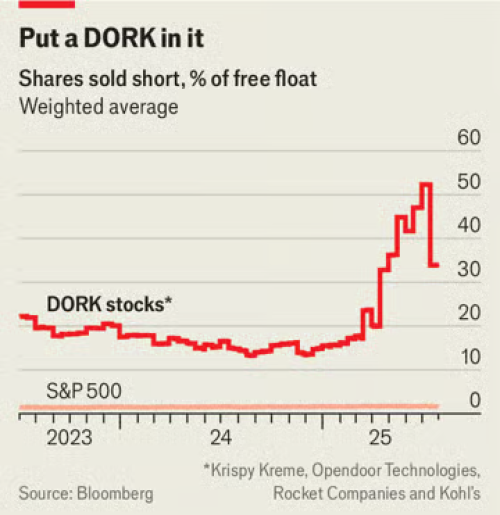
Other signs of fervour abound. Transactions in zero-day options, contracts favoured by day-traders that expire the same day, have surged in recent years. According to Cboe Global Markets, an exchange, a record 2.1m changed hands in the second quarter of 2025, up from 1.4m a year earlier. The exchange thinks retail investors account for at least half of such trading.
In 2020 and 2021 the combination of loose monetary and fiscal policy was often credited for the surge in speculation. Covid-era stimulus cheques (or “stimmies”) delivered cash directly to budding retail traders just as everyone was forced to stay at home all day. Robin Greenwood, Toomas Laarits and Jeffrey Wurgler, three academics, tested the theory in 2023. They found that the handouts in both Hong Kong and America led to an abnormal boost in the price of stocks popular with retail investors.
That cannot be the explanation today. The last stimmies landed on American doorsteps four years ago. Monetary policy, meanwhile, has been tightened: the Federal Reserve’s balance-sheet has shrunk and ten-year Treasury yields are above 4%. Researchers at the San Francisco Fed reckon Americans’ pandemic-era savings were exhausted more than a year ago.
But even without the help of stimulus money, retail investors with a zeal for speculation continue to transform the markets. Such traders now account for about 20% of total American trading volume. That is down from around 24% at the 2021 peak, but well above the 10-16% of the 2010s.
The change has been driven not by government handouts, but by technology. App-based platforms have given individuals easy access to leverage and a wide range of securities to choose from. It is no surprise that the share price of Robinhood, among the largest of the new online brokers, has risen by 169% this year. Investing now appeals to a greater range of Americans. According to JPMorgan Chase, more of the bank’s customers are transferring money to an investment account. The share of high-income customers doing so doubled between 2015 and 2023. For low-income customers, the share quadrupled.
Beyond greater speculation, the long-term consequences of a more retail-heavy market are not yet clear. Some investors fear it is already having a negative effect. Cliff Asness, founder of AQR, a quant fund, thinks it is perhaps the biggest contributor to declining market efficiency. “Technology, gamified 24/7 trading on your phone, and social media in particular are the biggest culprits,” he wrote in 2024.
The big test will come during the next serious downturn. When the S&P 500 swooned earlier this year, falling by more than 20%, retail traders dashed to buy the dip, and a rapid recovery followed. But the drop was a modest one by historical standards. In a deeper slump, paired with a recession, would the DORK-buyers and their brethren be so brave? Sooner or later, investors will find out.
The articles may contain material provided by third parties derived from sources believed to be accurate at its issue date. While such material is published with necessary permission, the Westpac Group accepts no responsibility for the accuracy or completeness of, nor does it endorse any such third-party material. To the maximum extent permitted by law, we intend by this notice to exclude liability for third-party material. Further, the information provided does not take into account your personal objectives, financial situation or needs and so you should consider its appropriateness, having regard to your personal objectives, financial situation and needs before acting on it.