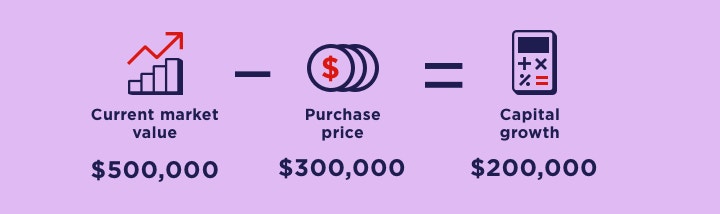
With any property purchase, buyers ultimately want the property’s market value to rise. You need to keep in mind, however, that capital growth is never guaranteed. Over time, markets and demand can rise and fall, and property can go up or down in value. Remember that regardless of the property’s current market value, you will still need to be able cover the costs of your home loan.
For some investors, choosing capital growth as a strategy involves holding the property long-term in order to see growth over time. Some investors choose to purchase property in areas known for reliable capital growth as their investment strategy, even if this means the property may not generate an adequate rental income to cover the costs of owning the property.
Rental yield and income
As an investor, you’re likely to rent out your property to tenants, offering an ongoing income stream. For some investors, this is the main goal – to comfortably cover all costs and provide a passive income stream. However, you’ll need to have funds to cover times when you don’t have tenants or rental income from your investment property.
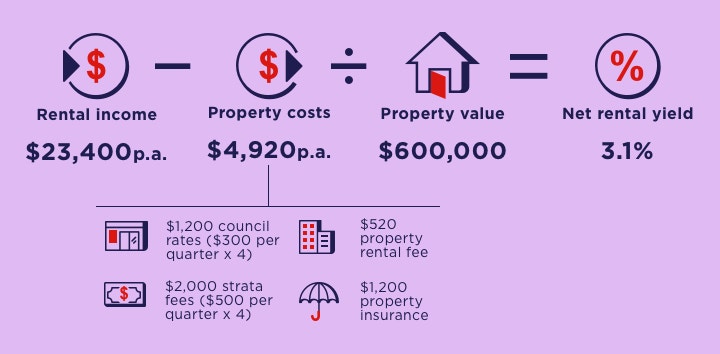
Rental yield is a calculation to estimate the potential income from an investment and to compare properties. It's often calculated as either gross rental yield (a simple view) or net rental yield (a complex but more accurate view).
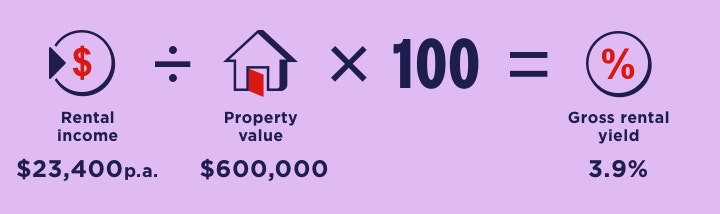
Gross rental yield is the amount of rental income you can receive over a year, measured against the market value of the property. It’s commonly used as a way to compare properties with different values and rental returns. There’s a quick, easy way to calculate the gross rental yield of a property – take a look at the example below or use Westpac’s Property Research Tool to look up a property and see the estimated rental yield.
Gross rental yield example:
- George purchased an investment property for $600,000
- He rents it out at $450 per week
- The gross rental yield is the annual rental income ($450 x 52) = $23,400 / $600,000 x 100 = 3.9%