Having pocket money is exciting – when you have your own money, you can make choices. Maybe you buy a game, save for something bigger, or donate to a cause you care about.
Maybe you’re happy to get the money that’s given to you when you earn it for completing chores, or maybe you want to earn more money.
Pocket money is not unlimited
Your parents or caregivers work to earn money, and they will probably get paid a certain amount every month.
With pocket money, you could also get given a certain amount. If you get $10 and then you spend it all, you’ll have to wait until you get more.
Examples of ways to earn pocket money at home
- Allowance: A small amount of money you get each week or month.
- Extra chores: There are probably some chores you need to do, but you can ask to do extra work for an agreed amount. This could include things like folding laundry, making other people’s beds, mowing the lawn, or watering plants.
- Goals and milestones: When you try hard at school, get good marks, score a goal in a game, or celebrate a birthday you may get a certain amount of money as a reward or gift.
Even more ways to earn pocket money
Looking to really boost your earnings? Here are some activities to consider with the help of your parents or caregiver:
- Arts and crafts: Have fun and get creative. Paint, draw, knit or sew to make items that you can sell to friends or family, or online with some help from your parents or caregiver.
- Stalls: Sell lemonade on a hot day or tasty baked goods at lunchtime on weekends.
- Garage sale: Help tidy up and sell those items around the house that your family is no longer using.
- Recycling: Most Australian states have a container deposit scheme that allows you to exchange recyclable items such as cans and bottles for cash.
Look up your local container deposit scheme
How to manage your pocket money
Once you start earning money, you need to think about the best way to save, spend, manage and store it.
Saving and spending
- Budgeting: A budget is a plan you make to keep track of your money and decide how you want to use it.
- Saving versus spending: Consider how much money you want to keep or save for a longer time, versus how much you want to spend right away.
For example, if you want a bike that costs $200 and you get $20 per week, you can get the bike in 10 weeks if you don’t spend money on anything else. But, if you decide that you want to buy treats or other smaller items each week, then you’ll need to wait longer for your bike. - Giving: Donating money to charity is a way to help others. If there is a cause that means something to you – maybe a food bank, an animal shelter, or a cancer research organisation – you can set aside some money to give.
Organising and keeping your money safe
- Jars and piggy banks: You can keep all of your money in one container at home or use separate containers to help manage your budget. For example, you could have a jar for saving, a jar for spending and a jar for charity.
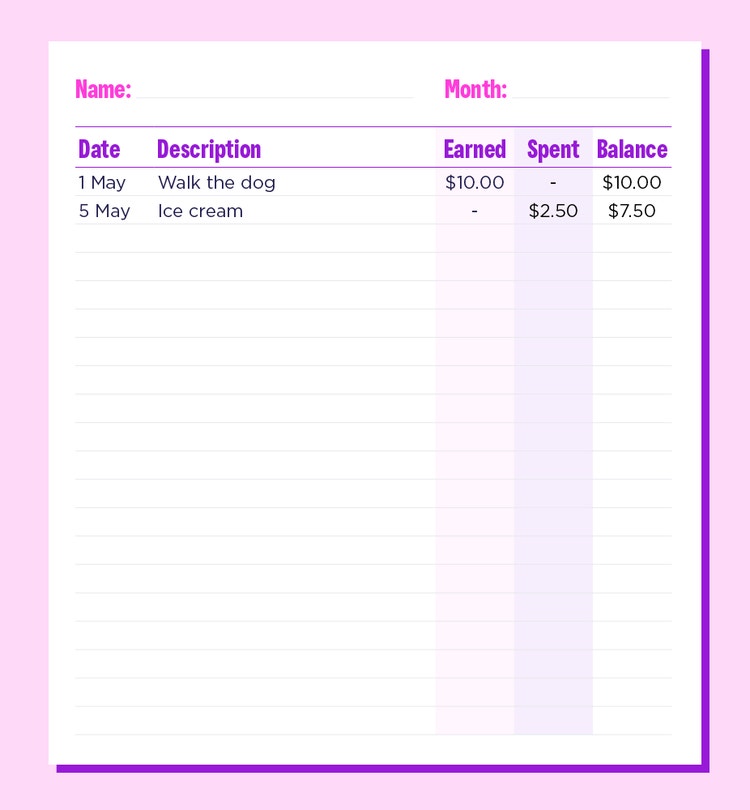
- Writing it down: Writing down what you earn and spend is a good way to keep track of things. To start out simply, use a pen and paper or notebook and divide the page into two sides: money in (earned) and money out (spent).
You can also be more detailed and include the dates and what you spend the money on or how you earned it. Do this on a monthly basis and add up the total each time to see how much you’ve spent and saved.
Here is an example of what your tracker might look like: