What is interest?
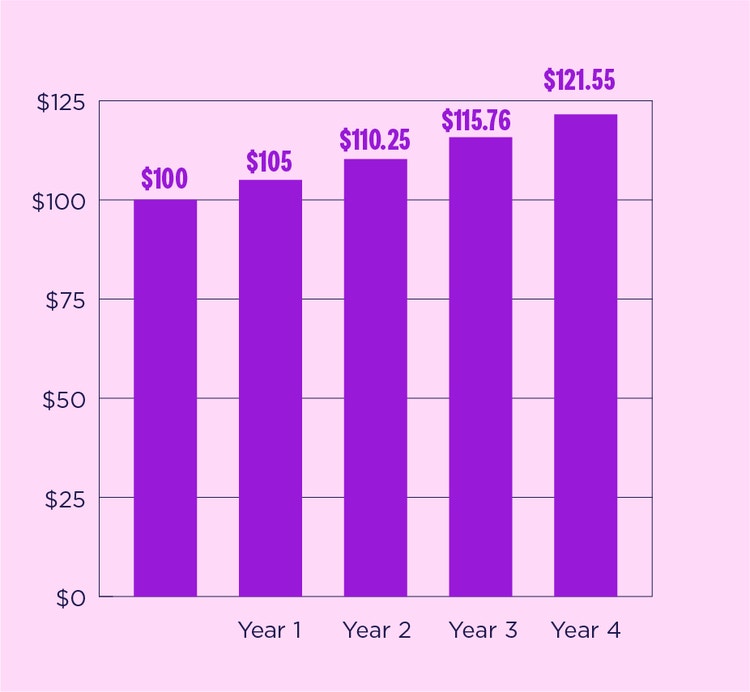
Banks need money to be able to provide loans to customers and operate their business. When you deposit your money with a bank, they may pay you a bit of extra money for keeping your money with them.
This extra money is called interest.
The bonus amount the bank pays you is based on its interest rate – which is a percent, or a fraction, of the total amount of money in your bank account.
For example: if you have $100 in your bank account and the bank has an interest rate of 5% p.a. per year (or per annum), you will get $5 extra for that year from the bank.
Or, if you have $50 in your bank account and the interest is 5% p.a. p.a., you will get $2.50 extra.
How to calculate interest
- Divide the interest rate by 100. Example: The interest rate 5% p.a. p.a. so 5/100 = 0.05
- Multiply the number you calculated in step one by the amount of money you have. Example: You have $50 so 0.05*$50 = $2.50