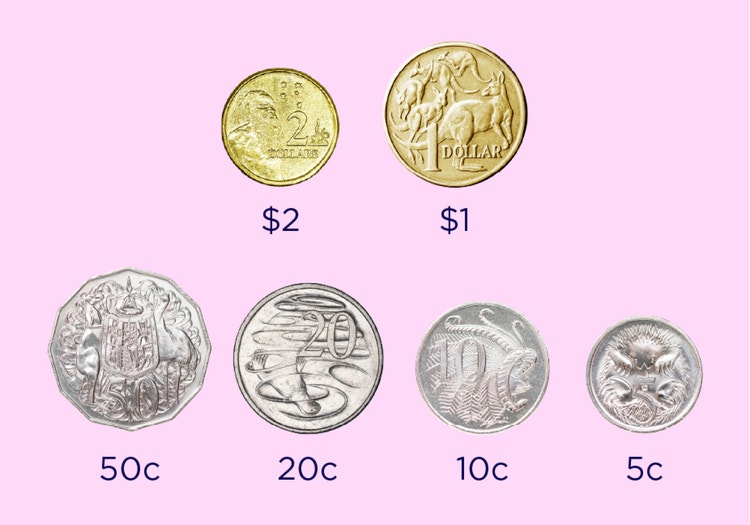
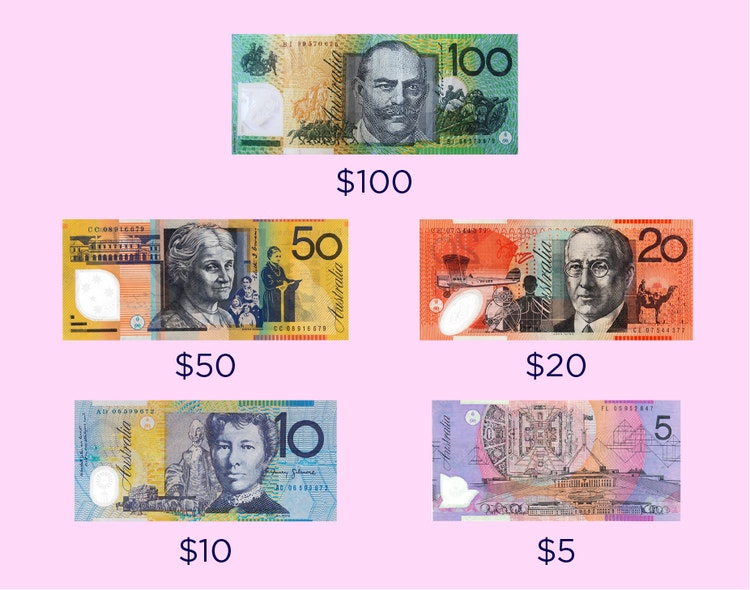
Each note has two sides. Australian notes all feature important Australians and special Australian designs. The five-dollar note currently features Queen Elizabeth II on one side. A new five-dollar note is being designed to honour the culture of First Australians.
There are five types of Australian notes
- 5 dollars
- 10 dollars
- 20 dollars
- 50 dollars
- 100 dollars
Fun facts about Australian notes
- Like coins, each note is a different size, so you can feel the difference when holding them.
- Each note also has a different colour. This way it is very hard to mix up the larger yellow 50-dollar note and the smaller purple five-dollar note!
- Australia was the first country to print notes on polymer plastic instead of paper. Plastic notes are stronger, harder to copy, and last longer than paper notes.
- There used to be one- and two-dollar notes. The one-dollar note was replaced with a coin in 1984, and the two-dollar note was replaced with a coin in 1988.
Understanding dollars ($) and cents (c)
One dollar is made up of 100 cents:
- 1 dollar equals 100 cents
- 2 dollars equal 200 cents
- 5 dollars equal 500 cents
'$' is the dollar symbol. It always goes before the number:
'c' is the cent symbol. It always goes after the number:
Writing dollars and cents as a number
When you are writing dollars and cents as a number together, you only need to use the dollar sign.
The dollar amount goes on the left before a decimal place, and the cent amount goes on the right after a decimal place.
For example:
- One dollar and 50 cents looks like this: $1.50
- Two dollars and five cents looks like this: $2.05
Practice on your own
Work out the below values as numbers on your own, then scroll to the bottom of the page for the answers.
- 3 dollars and 5 cents
- 5 dollars and 20 cents
- 20 dollars and 10 cents
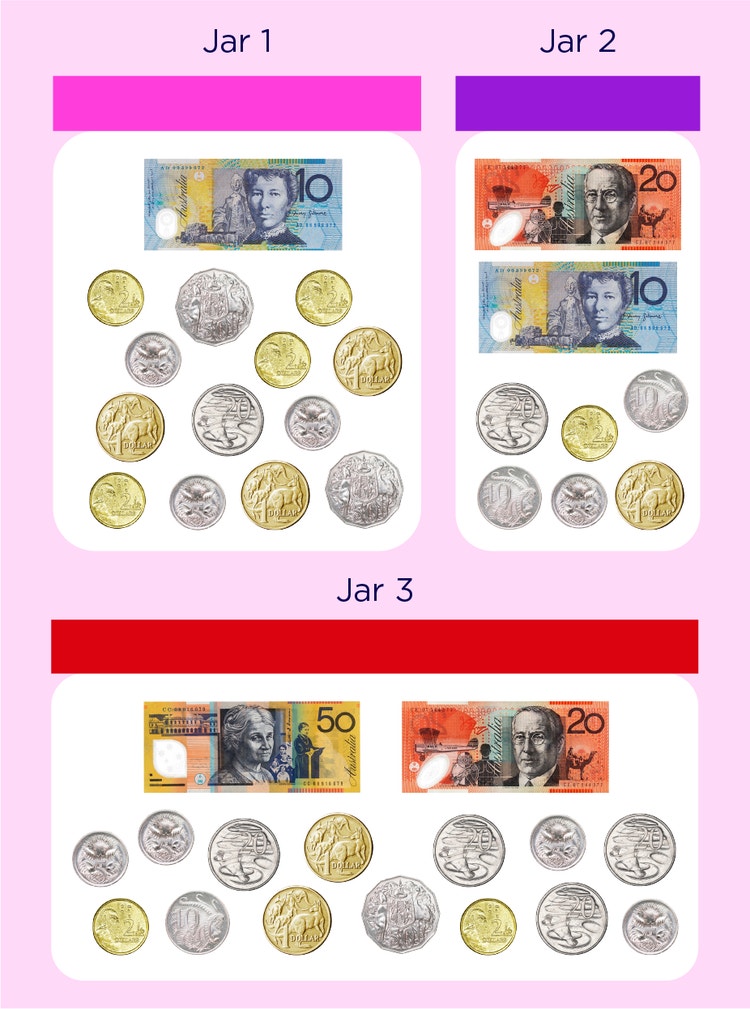
Quiz time: How much money is in each jar?
Count the money in each jar, then scroll to the bottom of the page for the answers.